19 May 2026
Which Dupatta Suits Your Lawn Suit? Chiffon vs Net vs Organza
The dupatta decides how formal a lawn suit looks and how easily it drapes. Chiffon, net, organza and matching lawn compared — how each behaves, and which suits your shirt.
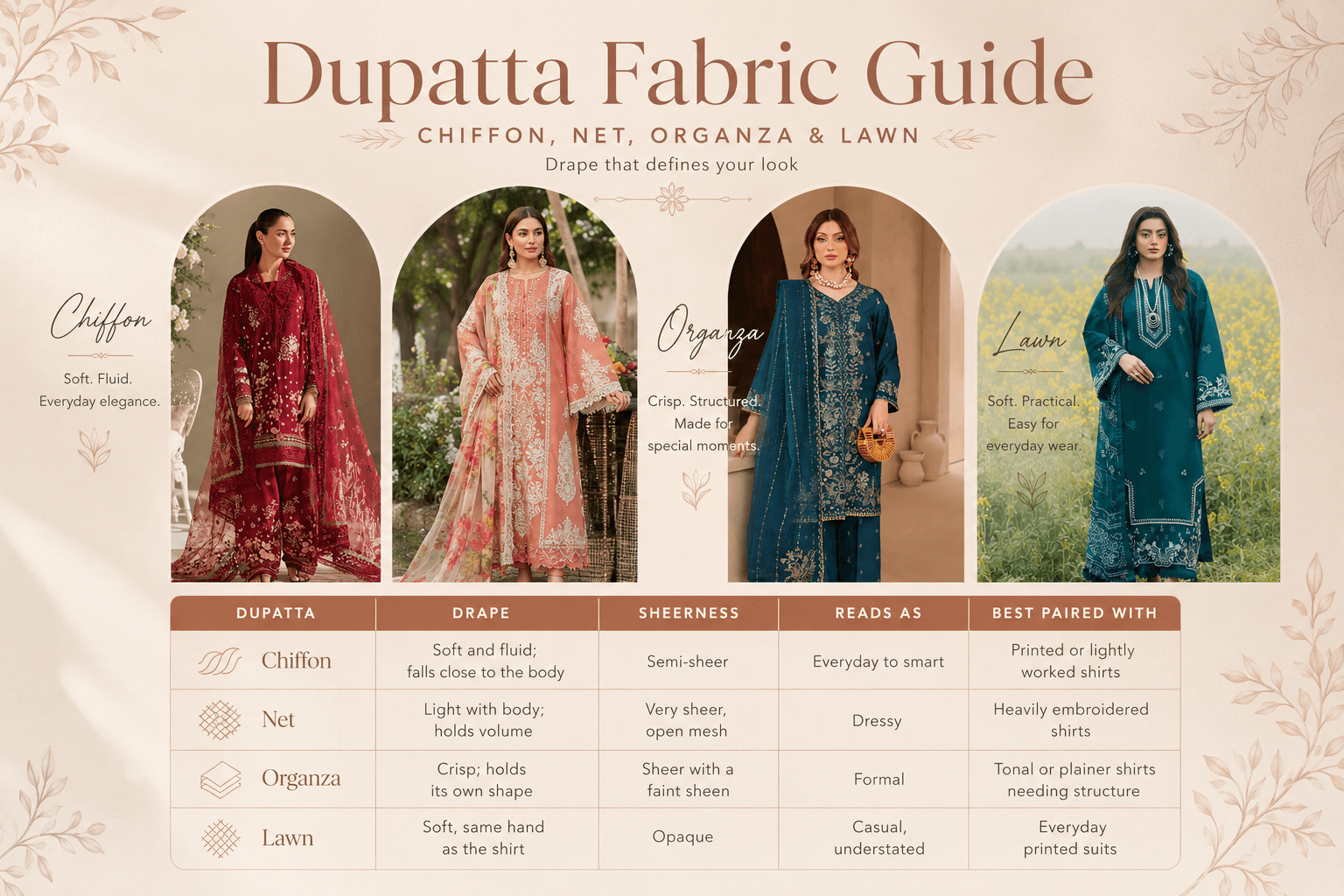
Choose by drape and by how worked your shirt is: chiffon falls softest and suits everyday wear, net adds volume without weight over a heavily embroidered shirt, organza holds its shape for formal looks, and a matching lawn dupatta is the most practical and most covering option.
The dupatta is the piece buyers think about last and notice most. It changes how formal a suit reads, how easy it is to keep in place, and how much of the shirt's embroidery you actually see.
Chiffon, net, organza and lawn compared
| Dupatta | Drape | Sheerness | Reads as | Best paired with |
|---|---|---|---|---|
| Chiffon | Soft and fluid; falls close to the body | Semi-sheer | Everyday to smart | Printed or lightly worked shirts |
| Net | Light with body; holds volume | Very sheer, open mesh | Dressy | Heavily embroidered shirts |
| Organza | Crisp; holds its own shape | Sheer with a faint sheen | Formal | Tonal or plainer shirts needing structure |
| Lawn | Soft, same hand as the shirt | Opaque | Casual, understated | Everyday printed suits |
When is chiffon the right choice?
Chiffon is the default for a reason: it is the softest of the four and the least demanding to wear. It falls close to the body without adding bulk, which keeps a summer suit feeling light, and it is semi-sheer rather than transparent, so it works without careful arrangement.
It suits printed and lightly worked shirts best, where you want the dupatta to soften the look rather than compete. Most of the range pairs this way — you can browse lawn suits with a chiffon dupatta directly, from everyday pieces like the ivory floral printed suit to cutwork-edged versions such as the maroon printed suit with a cutwork chiffon dupatta, where the worked edge lifts a simple print.
When should you choose net?
Net is the answer when the shirt is already doing a lot. Its open mesh is the sheerest of the four, so it adds presence and volume without hiding the embroidery underneath — which is exactly what you want over a densely worked shirt.
It is also the least forgiving in handling: an open weave snags on jewellery and rough edges more readily than the others. Worth knowing rather than avoiding. Lawn suits with a net dupatta covers the range, including printed net versions like the sky blue chikankari suit, where the dupatta carries a print the shirt deliberately leaves out.
What does organza do that the others do not?
Organza holds its shape. Where chiffon and net follow the body, organza keeps a defined edge and a slight structure, and it carries a faint sheen that reads as more formal. That makes it the natural choice for a tonal suit that would otherwise look flat — the structure supplies definition that colour contrast is not providing.
The teal blue embroidered suit with an organza dupatta and the off-white chikankari suit with an organza dupatta both use it this way. The trade-off is that organza creases along fold lines and does not fall softly, so it is a poorer choice for a long day in heat.
Why choose a matching lawn dupatta?
A lawn dupatta is the most practical option and the most overlooked. It is opaque, so it gives full coverage; it shares the shirt's weight and hand, so the suit reads as one piece; and it needs no special handling. For everyday wear — particularly at work — it is often the better choice.
What it will not do is add formality. Suits such as the sage green printed suit with a lawn dupatta are deliberately understated, and that is the point.
What the dupatta edge does
The finish on the edge changes a dupatta as much as the fabric does, and because an unstitched suit supplies the dupatta as raw fabric, this is a decision rather than a given:
- Plain hem. The simplest and lightest. Keeps a chiffon or lawn dupatta reading as everyday.
- Cutwork edge. A shaped, cut-out border that adds detail without weight — the reason a simple printed suit can look considerably dressier with no change to the shirt. Several printed suits pair this way, including the maroon printed suit with a cutwork chiffon dupatta.
- Lace or trim. Adds visual weight at the edge. Effective on a plain dupatta, distracting on a printed one.
- Four-side embroidery. The most formal, and the heaviest. Best when the shirt is plain, or it becomes too much.
Common pairing mistakes
Three that come up repeatedly, all easy to avoid:
- Pattern on pattern. A printed dupatta over a printed shirt rarely works unless the two prints share a scale and a palette deliberately. When in doubt, one piece carries the pattern.
- Near-miss colour matching. A dupatta one shade off the shirt looks like a mistake; a dupatta clearly in a different tone looks like a choice. If you cannot match exactly, do not try to.
- Formality mismatch. An organza dupatta over an everyday printed shirt reads as two outfits rather than one. Keep the dupatta within a step of the shirt's register.
How to decide in one step
- Busy, heavily embroidered shirt? Plain net or plain chiffon. Do not add pattern.
- Plain or tonal shirt? Organza for structure, or a printed dupatta to supply the contrast.
- Printed shirt? Chiffon in a tone taken from the print, or matching lawn.
- All-day wear in heat? Chiffon or lawn. Both fall softly and neither needs arranging.
If the dupatta is your deciding factor, browsing by it is faster than filtering a whole catalogue — and it is worth remembering that with an unstitched suit the dupatta is supplied as fabric, so its finishing is still yours to decide.